

Ex-Trump strategist Steve Bannon steps up his efforts to influence EU far-right parties. But experts doubt he will be able to overcome fragmentation to unite a populist coalition ahead of the 2019 elections.
In July this year, Donald Trump’s ex-strategic adviser, Steve Bannon, announced the birth of “The Movement”, a Brussels-based foundation which aims to bring Eurosceptic and populist forces together ahead of the European Parliament elections to be held in May 2019.
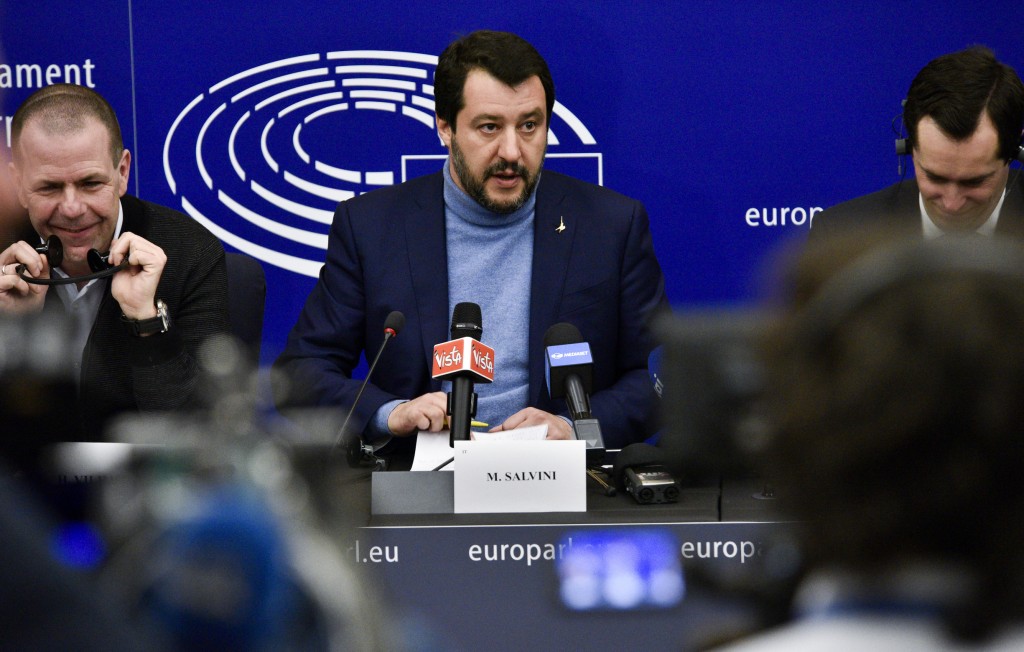
During the past months, the former White House top aide has started building his network. The Italian interior minister and leader of the anti-immigrant party Lega Nord, Matteo Salvini, has joined the initiative, while Mischaël Modrikamen, co-founder and leader of the Belgium People’s Party, is his executive director.
However, the far-right Freedom Party of Austria (FPÖ) and Alternative for Germany (AfD) have rejected Bannon’s offer.
“Money and media”
Meanwhile the possible influence of the new foundation is discussed beyond the Brussels bubble.
Bannon can provide money and media attention to a right-wing populist coalition, political analyst Basile Ridard, from the think thanks Egmont Institute, told Euranet Plus
Dr Basile Ridard Senior Research Fellow of European Affairs at Egmont Institute (in French)
Click on the button to load the content from Soundcloud.
“He is trying to achieve his goal by providing some funding, by proposing to these parties to finance polls to be able to design a clearer political discourse to gain electoral advantage. “
In this way, Bannons foundation could help these parties to take advantage of the current climate in parts of Europe, mainly against migratory movements and, in general, against the idea of stronger European integration, Ridard said.
However, Ruth Wodak, a distinguished expert on political discourse of xenophobic movements, argues that there is nothing new in Bannon’s approach. She doubts his influencing ability.
Ruth Wodak, Distinguished Professor of Linguistics at Lancaster University (in English)
Click on the button to load the content from Soundcloud.
“I don’t think that Bannon is transporting something new to these far-right parties. In that way, I also do not believe – and many of my colleagues do not believe – that he will be so influential. Bannon has left the US, so he is trying to find a new fight to be influential. Because, basically, he lost much of his influence with Trump.”
Bannon’s handicaps
Those reluctant to US interference are sceptical about Bannon’s knowledge of EU politics. For instance, some elements of his American agenda, like supremacism or religious fundamentalism, are not issues in the old continent, Wodak explained.
Ridard also points out Europe’s political fragmentation as a key handicap.
Dr Basile Ridard, Senior Research Fellow of European Affairs at Egmont Institute (in Engliosh)
Click on the button to load the content from Soundcloud.
“Some far-right parties are not ready to follow Bannon’s strategy and probably Mr. Bannon and his team have underestimated the complexity of the traditional game of party politics in Europe.”
Role of the press
Although very little is known about The Movement’s funding, structure or agenda in current EU politics, Bannon has managed to slip in the European political debate.
Alberto Alemanno, a prolific academic and a pro-European political activist, believes the media is partially responsible for this.
Alberto Alemanno, Jean Monnet professor and political activist (in English)
Click on the button to load the content from Soundcloud.
“We know very little about the practicalities and timelines of Steven Bannon’s project. We felt that he made an announcement in order to make a splash, in order to draw interest and to have the conversation we are having today. So, I think the media is also partly responsible for, in a way, supporting his visions, which probably is not turning into a reality yet”.
The Austrian expert Wodak also stresses the need to avoid exaggerations over his personality by the media, which could actually serve his goals.
Ruth Wodak Distinguished Professor of Linguistics at Lancaster University (in English)
Click on the button to load the content from Soundcloud.
“The more we kind of predict or try to predict what he will achieve, the more he will achieve it, like a self-fulfilling prophecy. I do not think he is that important.”
- Author: Natalia Segura, Euranet Plus News Agency
