

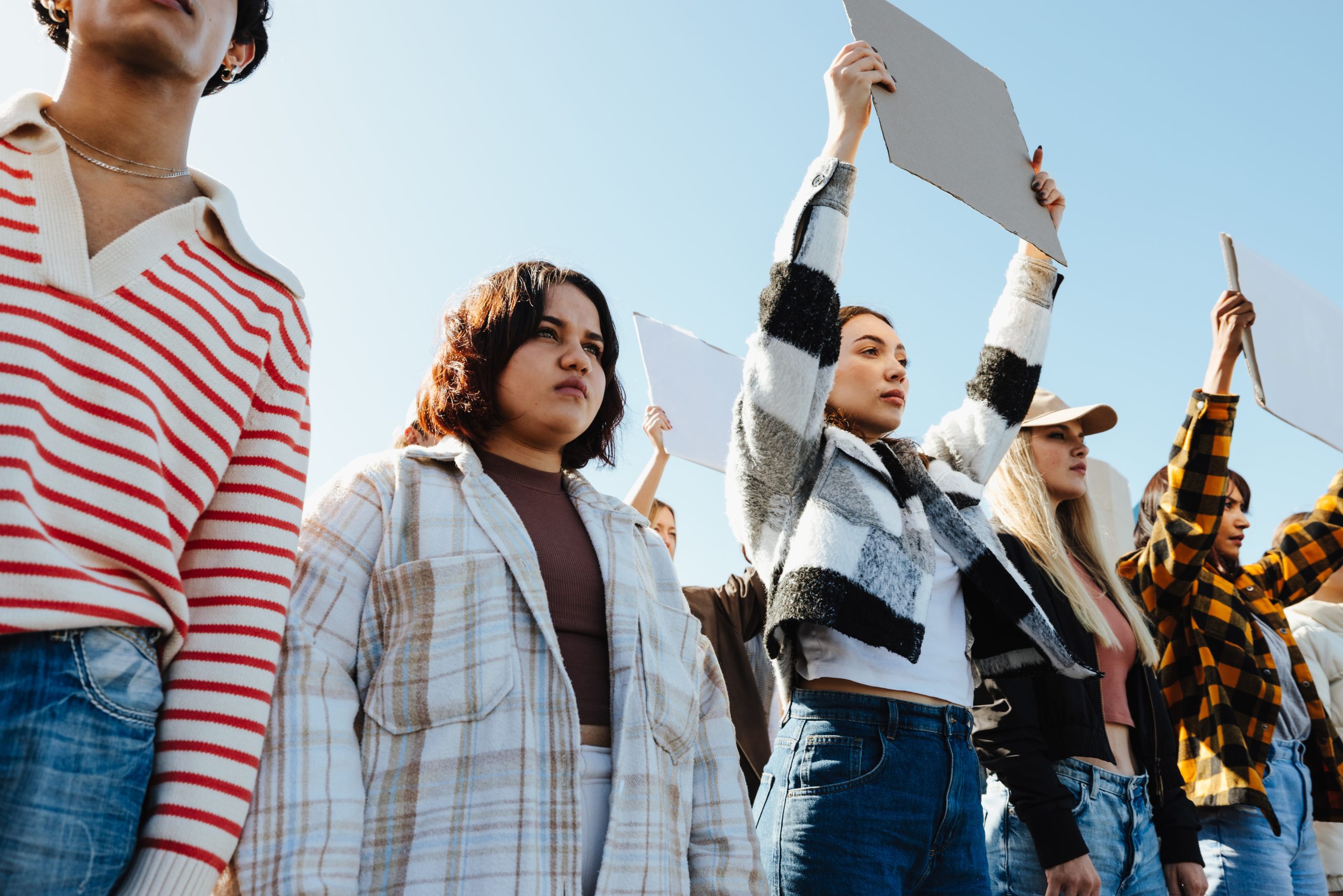
Politics should tackle young voters’ scepticism head-on, as failure to act risks losing them for good… and losing itself in the process.
The gradual erosion of trust in democratic institutions and the political sphere appears to be particularly prevalent among young people. Is this scepticism and systematic mistrust becoming their default mindset?
A willingness to act – for change
Young people are feeling a sense of detachment from our democracies of old, and are calling for change. But according to Professor Alessandro Rosina, of the Catholic University of Milan, this is not necessarily a bad thing.
Alessandro Rosina, Professor of Demography and Social Statistics, Faculty of Economics, Catholic University of Milan, Interview by Giulia Cannizzaro, Radio 24 (in Italian)
Click on the button to load the content from Soundcloud.
“This detachment does not necessarily coincide with apathy. Young people are interested in experimenting with unconventional forms of civic engagement. They are also willing to mobilise when they feel called upon by goals they consider significant and when they feel part of something that is changing in line with their own values.”
Psychologist Dimitris Katsikis agrees. Young people want to be more, not less, involved.
Dimitris Katsikis, Psychologist, Interview by Nikos Andritsos & Marianna Pliakostamou, SKAI (in Greek)
Click on the button to load the content from Soundcloud.
“I wish to point out that this ‘fatigue’ you are talking about actually reflects the exact opposite of what it appears to indicate; it reflects people’s desire to participate more in collective decision making. It expresses their need to be part of building things, rather than being far removed from what we call ‘professional politics’.”
Fidias Panayiotou is one such young person pushing towards change. The 25-year-old Cypriot has been a serving member of the European Parliament since July 2024. Panayiotou boasts of fully applying the idea of direct democracy, with his political line based solely on the wishes of his supporters. His revolutionary concept has attracted 2.7 million YouTube followers and our colleagues at Renascença met him at the last Web Summit in Lisbon.
Fidias Panayiotou, Member of the European Parliament (Non-attached, Cyprus), Interview by José Pedro Frazão, Radio Renascença (in English)
Click on the button to load the content from Soundcloud.
“Democracy is boring. I don’t think it’s the best system. Democracy has many problems. That’s why we – the younger generation – need to get involved in politics, as I am doing, like many other young people, to change the things we want to change. Perhaps towards direct democracy, perhaps to improve things. Politics is broken, including in Europe. We, the young generation as a whole, must try to change that. I didn’t believe it was possible, but I ran as an independent in Cyprus and received the most votes of all Cypriot candidates for the European Parliament. So, it is possible.”
Be wary of novelty
However, promoting change for the sake of it can be deceptive, and so do discourses that promise to bring about changes. They may in fact promote values and visions that go against the principles and values we Europeans have long defended. This is what concerns Antonio García Maldonado, a Spanish analyst and public affairs consultant: the risk that young people stop believing in the system and seek alternatives that are not democratic.
Antonio García Maldonado, Director of public affairs with experience at the Ministry of Foreign Affairs and as a consultant in Brussels, Interview by Aitana Sánchez, esRadio Castilla y León (in Spanish)
Click on the button to load the content from Soundcloud.
“What we are seeing now are challenges to the democratic system itself, to the way in which it operates. And that is what worries me.”
Green MEP Nicu Ștefănuță, vice-president of the European Parliament, won his seat in the European Parliament on the back of youth support. He calls on young people to resist polarisation by learning to compromise in society.
Nicu Ștefănuță, Vice-President of the European Parliament (Greens/EFA, Romania), Interview by Mihaela Ioncelescu, Radio România (in Romanian)
Click on the button to load the content from Soundcloud.
“Compromise is extremely important, both in politics and in society. Compromise means being able to find common ground, being able to live with someone who is different from you. I often tell young people, for example, that yes, my father posts and sends me videos and TikToks featuring political figures from a completely different part of the political spectrum – but I don’t hate my father, I love my father!”
Can things be fixed… somehow?
But young people are not the only ones with things to learn. One thing that our politicians and leaders often forget, for example, is that trust is earned. And how is it earned? By fixing citizens’ problems, says Spanish observer Antonio García Maldonado.
Antonio García Maldonado, Director of public affairs with experience at the Ministry of Foreign Affairs and as a consultant in Brussels, Interview by Aitana Sánchez, esRadio Castilla y León (in Spanish)
Click on the button to load the content from Soundcloud.
“What I believe is that democracy has to take its role as a problem solver much more seriously and not boast so much about its moral virtues.”
If leaders want to build trust and demonstrate that politics serves citizens, citizens must feel that the state is working for them, effectively and fairly. However, here it appears to be more about perception than measurable results, with studies showing that expectations about the future, media narratives, quality of life and personal finances make more of an impact than objective figures on the health of the economy. Indeed, housing, healthcare and education are the strongest predictors of trust in institutions. And trust drops sharply during visible inflation spikes…
We live in an increasingly complex world, faced with political systems that are showing cracks and untamed social media. However, if politics is not to widen the divide and thereby encourage the emergence of new anti-establishment and anti-democratic parties, it must have the courage to reform itself and make more room for young people, so that they are ready and willing to act to keep Europe on the right path.
On the same topic:
- Author: Hermine Donceel, Euranet Plus News Agency
